Viktor Bernik
BIO
In 1998, Viktor Bernik graduated from the Academy of Fine Arts in Ljubljana with a degree in painting, and then completed his postgraduate studies there. He pursued further studies in the United States. His practice focuses largely on the uneasy encounters between art and the everyday, and on the issue of social space and the ways art can enter it. The formal solutions Bernik uses in his projects are varied. He approaches issues of modern society with playfulness and humor, and it is a similarly relaxed attitude that allows him to move from painting to drawing, video, and prints, as well as to installations, interventions, and events.
Bernik has shown his work in numerous exhibitions in Slovenia and abroad, such as HA, HA, HA (T001 Gallery, Ljubljana, 2020), Window – a Hole in the Museum (Museum of Contemporary Art Metelkova, Ljubljana, 2021), The End (This is not a themed exhibition), (Nova Gorica City Gallery, 2023), Time Without Innocence: Recent Painting in Slovenia (Moderna galerija, Ljubljana, 2019), Better Doggy Style Than No Style (Ljubljana City Art Gallery, 2016), Crises and New Beginnings: Art in Slovenia 2005–2015 (Museum of Contemporary Art Metelkova, Ljubljana, 2015), the 30th Biennale of Graphic Art (Cankarjev dom, Ljubljana, 2013), The Present and Presence (Museum of Contemporary Art Metelkova, Ljubljana, 2012), an untitled project in Mala galerija (Moderna galerija, Ljubljana, 2009), Museum in the Streets (Moderna galerija, Ljubljana, 2008), and The New Ten (Kunsthaus, Vienna and MKM Museum Küppersmuhle, Duisburg, 2004), among others. He is the author of the Made in China project and the founder and one of the heads of the artist-run GalerijaGallery. He teaches at the Academy of Fine Arts and Design in Ljubljana, and at the Faculty of Education of the University of Maribor.
WORK AT THE EXHIBTION
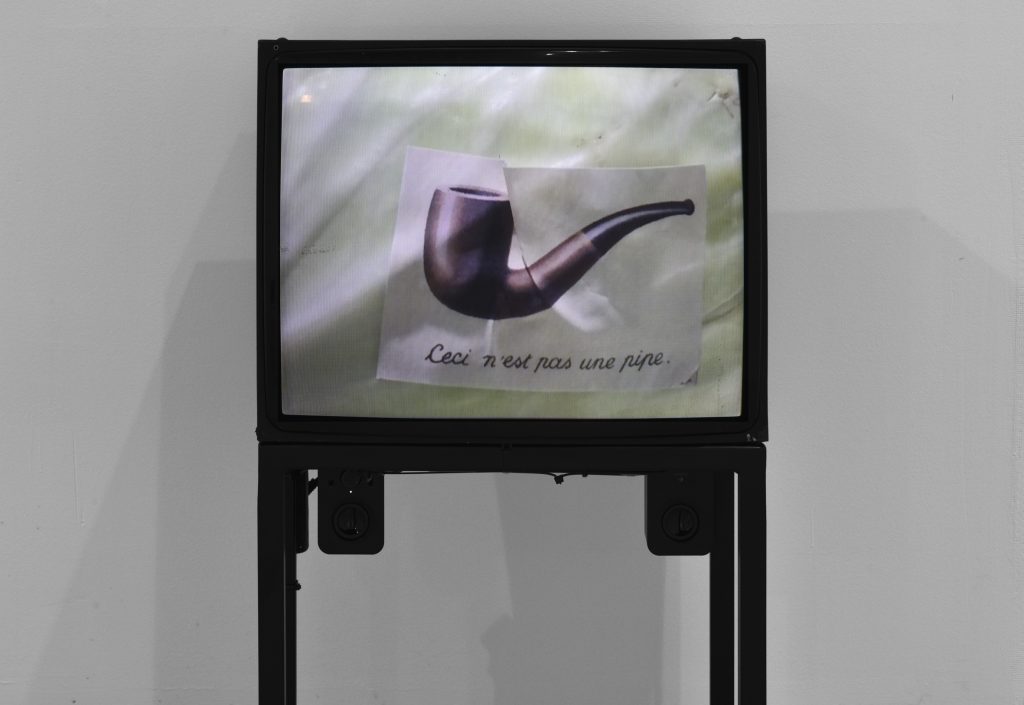
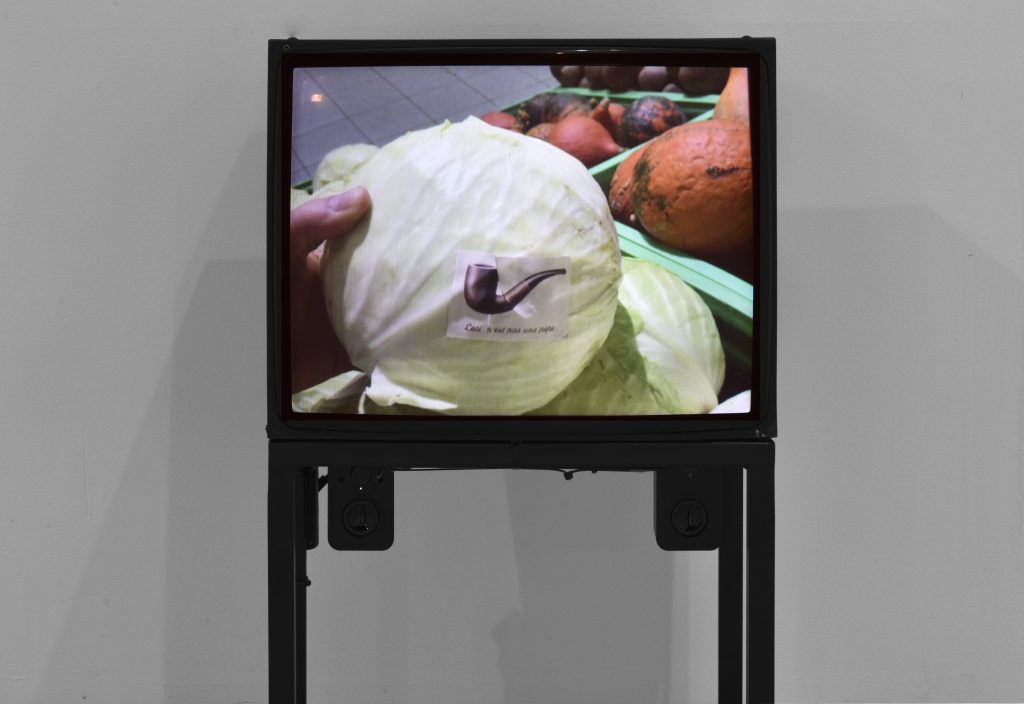
Small Poetic Moments in the Life of a Consumer, 2024
video based on the documentation of the artist’s interventions in public spaces reserved for commerce, sound (by Klemen Gabrijelčič)
The video Small Poetic Moments in the Life of a Consumer is based on the documentation of an ongoing project of the same title. The project comprises a series of the artist’s interventions in places reserved for commerce: putting stickers with images on the store’s products, repositioning the goods on sale, and transforming the constellations (or compositions) of the carefully arranged products. Since Bernik’s first intervention in one of the chain supermarkets in Ljubljana in 2013, the project has been realized in various European cities and in different types of stores. In these interventions, as in many other works, the artist deals with the space of consumerism, which he sees as the dominant contemporary environment where people spend their time, focus and money.
He employs his characteristic strategy – acts of subtle intervention in a given context – be it a museum or a gallery or a non-art public space – where art and reality merge into a particular and interdependent constellation. His interventions transform the original context and change the perception of these initially carefully constructed social spaces.
Even more than his other projects, Small Poetic Moments in the Life of a Consumer examines the possibilities and ways in which art can have a direct impact on the broader public/consumers, questioning the role of art in society at large today. He is aware that in order to address a wider audience the distribution of art is no less important than its production. Interventions in stores disrupt these carefully constructed spaces that are the result of complex processes that aim to optimize sales and enhance the overall shopping experience for customers.
In this project, a completely different logic inhabits the landscape of this curated consumer heaven. Perceived as either thoughtful or completely foolish and absurd, the project’s intention is to generate tiny poetic disturbances in the precisely planned world of commerce, structured for optimal financial gain – in public places that most people know best and where they feel most at home.
This strategy is similar to that of the Italian Futurists who, more than a hundred years ago, recognized that if they wanted to reach a wider audience, they had to exit the museums and enter the theaters, where many people spent their time. Another discernible link is with the Situationists, with their critique of capitalism, alienation and so on. It is not by chance that Bernik’s first intervention was a sticker for a children’s sticker album issued by the Spar supermarket chain, one with a penguin on it, over which he wrote the words of Asger Jorn: “Avantgarde doesn’t give up.”
The video work at the exhibition is a specific adaptation of the experience of an imaginary subject confronted with these interventions. The video was created and is presented in such a way that it fits in a contemporary art exhibition unproblematically – almost as a contemporary art cliché, while being at the same time directly related to store surveillance monitors. The artist employed sound in the same manner – an abstraction of the sounds of cash registers set to music gives the flow of images a rhythm. The strategy of blending contemporary art protocols with the protocols of commercial spaces is again something that the artist often employs, and it results in a situation where art and everyday reality merge into a particular interdependent constellation.
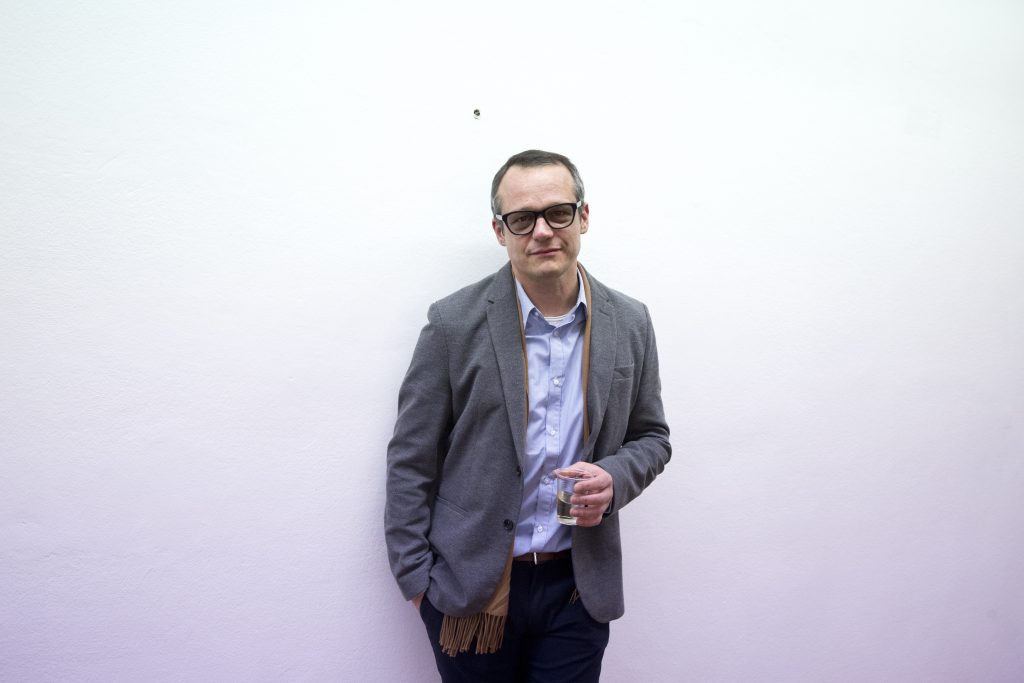
Profile photo: from the exhibition “Self Portrait”, photo by Borut Krajnc